
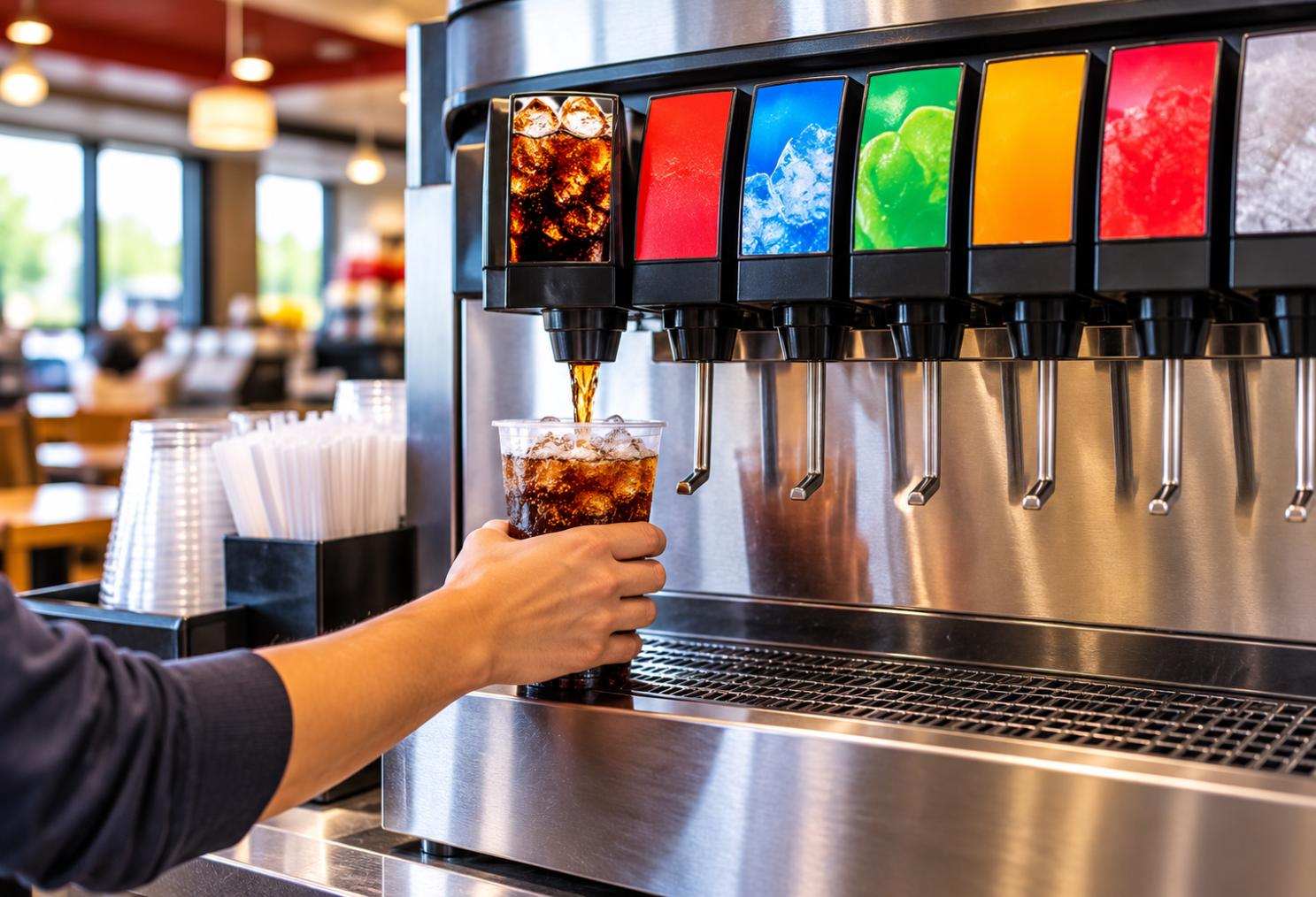
For restaurants and convenience stores in Collierville and across West Tennessee, fountain beverages can be a high-volume part of daily service. The right dispenser needs to keep drinks moving during lunch rushes, evening traffic, and busy weekend periods without creating unnecessary cleaning or maintenance headaches.
Choosing a fountain beverage dispenser comes down to matching capacity, configuration, ice requirements, available space, utilities, and service needs to the way your business actually operates.
Quick answer: Tennessee restaurants and convenience stores should choose fountain beverage dispensers based on expected drink volume, number of flavors, available counter space, ice production, water supply, cleaning requirements, and access to equipment service. A small restaurant may need a compact countertop system, while a busy convenience store along a major traffic corridor may benefit from a larger self-service setup.
What local operators should know
- Fountain equipment should be sized for peak demand, not simply average daily beverage sales.
- Collierville businesses should account for their available water connection, drainage, electrical service, and equipment footprint before selecting a unit.
- Convenience stores serving commuters around Poplar Avenue, Highway 72, and Highway 385 may have different capacity needs than a smaller dine-in restaurant.
- Ice capacity matters because Tennessee’s warm weather can increase demand for cold beverages during much of the year.
- Easy access for cleaning and routine maintenance can be just as important as the dispenser’s number of valves.
Why Fountain Beverage Dispenser Selection Matters for Tennessee Businesses
Fountain beverage dispenser selection matters because the equipment directly affects serving speed, drink consistency, counter space, cleaning routines, and the ability to handle peak customer demand. For Tennessee restaurants and convenience stores, choosing too small a system can create bottlenecks, while an oversized system can occupy valuable space without providing a meaningful operational benefit.
The needs of a quick-service restaurant near Collierville’s commercial corridors can be very different from those of a neighborhood restaurant or a convenience store serving drivers traveling between Memphis and communities farther east.
Southern Equipment Distributors helps commercial foodservice operators evaluate equipment for their specific operations. When we look at fountain beverage equipment, the goal is to consider the complete setup rather than treating the dispenser as an isolated purchase.
Local Data and Operating Considerations
Local utility and food-safety requirements should be part of the planning process before a fountain dispenser is purchased or installed. The Town of Collierville reports that its drinking water comes from deep underground aquifers and is processed through municipal water treatment facilities, with routine testing performed for water-quality parameters.
For a beverage system, operators should still follow the equipment manufacturer’s requirements for filtration, plumbing, water pressure, and maintenance. The characteristics of the building’s plumbing and the beverage manufacturer’s specifications can affect the filtration setup that is appropriate for an individual location.
Foodservice operators in Shelby County should also account for applicable health requirements. The Shelby County Health Department’s Environmental Health and Food Safety Program oversees food-service establishments and provides permitting and compliance information for local operators.
How the Right Dispenser Affects Daily Operations
The right fountain beverage dispenser can make beverage service faster, easier to manage, and better suited to the customer traffic a Tennessee business receives. Capacity, dispenser placement, ice availability, and flavor selection all influence how smoothly the beverage station performs during busy periods.
In a Collierville restaurant, a dispenser located behind the counter may need to support employees filling several orders at once. In a convenience store, the customer may be operating the machine, which puts more emphasis on intuitive controls, accessible cup placement, easy cleanup, and sufficient capacity.
The dispenser also occupies revenue-producing space. A configuration that provides the required beverage choices without unnecessarily crowding a service counter can improve the overall layout.
Warning Signs Your Current Beverage Dispenser May No Longer Fit Your Needs
Frequent bottlenecks, inconsistent dispensing, insufficient ice, and recurring service problems can indicate that an existing beverage system no longer matches the operation. Operators should evaluate the entire beverage station instead of waiting for a complete equipment failure.
Watch for these signs:
- Customers or employees regularly wait for access to the dispenser.
- The existing machine does not offer enough valves for your current beverage program.
- Ice supply struggles to keep up during peak periods.
- Drinks are dispensing inconsistently and routine adjustments are becoming more frequent.
- The unit is difficult for employees to clean thoroughly.
- Replacement components or repairs are becoming a recurring concern.
- The equipment takes up more counter space than its sales volume justifies.
- Business growth has increased beverage demand beyond the original system’s capacity.
When to Talk With a Commercial Equipment Professional
Talk with a commercial equipment professional before purchasing when capacity, utilities, dispenser configuration, or installation requirements are uncertain. A fountain system interacts with water, syrup delivery, carbon dioxide, ice, drainage, electrical connections, and the physical layout of the beverage station.
An operator can safely evaluate basic questions such as desired flavor count, available space, customer traffic, and whether beverages will be employee-served or self-service.
Equipment selection and installation planning deserve closer attention. This is particularly true when remodeling an existing Collierville restaurant, converting a retail space into foodservice, or replacing equipment with a substantially different configuration.
Common Fountain Beverage Dispenser Configurations
The most common fountain beverage configurations include countertop dispensers, drop-in systems, ice-and-beverage combinations, and higher-capacity self-service stations. The appropriate option depends primarily on how drinks are served and how much volume the location expects.
Countertop dispensers
Countertop units can work well where floor space is limited or where beverage volume does not justify a large station. They may be suitable for smaller restaurants, concession operations, and other compact foodservice environments.
Drop-in dispensers
Drop-in equipment integrates into a counter and can provide a cleaner built-in appearance. The counter dimensions and space below the work surface need to be considered before ordering.
Ice-and-beverage dispensers
Combining ice and fountain beverages in one station can simplify customer flow. These configurations can be useful for quick-service restaurants and convenience stores where customers fill their own cups.
High-volume self-service systems
Busy convenience stores and larger foodservice locations may need additional valves, greater ice capacity, or multiple dispensing positions. Locations serving traffic from Germantown, Cordova, Bartlett, Memphis, and surrounding Shelby County communities should size equipment around actual peak-period demand rather than choosing solely by store square footage.
Fountain Beverage Dispenser Maintenance and Cleaning
Regular cleaning and preventive maintenance help fountain beverage equipment remain sanitary, consistent, and dependable. Operators should follow the dispenser, beverage supplier, and component manufacturers’ cleaning and maintenance instructions rather than relying on a one-size-fits-all schedule.
Employees should routinely inspect accessible surfaces, nozzles, drip areas, ice dispensing areas, and surrounding counters. Syrup connections and other beverage-system components should be maintained according to the applicable supplier procedures.
Managers should also watch for changes in dispensing speed, beverage taste, carbonation, temperature, or ice production. A change in performance can signal that the system needs attention before the problem becomes disruptive.
What to Expect From a Properly Selected Fountain System
A properly selected fountain system should provide enough capacity for peak demand while fitting the available space and supporting practical cleaning and service access. It should also align with the restaurant or convenience store’s beverage menu rather than forcing the operation to adapt to poorly matched equipment.
For operators around Collierville, that means thinking beyond how the dispenser looks on opening day. Consider whether employees can access components, whether the ice supply matches summer beverage demand, and whether the configuration still makes sense when the store is busiest.
Common Fountain Equipment Buying Mistakes
The most common buying mistakes involve sizing equipment by price or dimensions alone instead of evaluating the complete beverage operation. A lower initial equipment cost can lose its appeal if the dispenser does not fit the counter, lacks needed capacity, or requires changes that were not considered beforehand.
Mistake: Choosing by valve count alone.
Consequence: The machine may offer enough flavors but lack the ice or dispensing capacity needed during peak traffic.
Better approach: Evaluate flavor count, peak transactions, cup sizes, and ice demand together.
Mistake: Ignoring utility requirements.
Consequence: Installation may become more complicated after equipment arrives.
Better approach: Confirm water, drainage, electrical, carbon dioxide, and syrup-system requirements in advance.
Mistake: Forgetting cleaning access.
Consequence: Routine maintenance becomes unnecessarily difficult.
Better approach: Consider how employees and service personnel will reach components after installation.
Mistake: Buying only for current volume.
Consequence: A growing Tennessee restaurant or store may outgrow its beverage station sooner than expected.
Better approach: Allow reasonable room for expected changes in customer traffic and beverage offerings without dramatically oversizing the equipment.
A Common Collierville Convenience Store Scenario
A common local scenario is a convenience store replacing an older fountain system while trying to increase beverage choices without sacrificing valuable sales-floor space. The operator may want additional flavors and larger cup options, but the existing counter, plumbing, ice capacity, and customer traffic pattern create practical limits.
Instead of starting with a particular machine, the better process is to document the available dimensions, expected peak beverage demand, desired number of selections, utility connections, and current ice needs.
That information narrows the equipment choices and helps prevent purchasing a dispenser that looks suitable on paper but does not work well in the actual store.
Related Beverage Equipment Solutions
A complete fountain beverage setup may require more than the dispenser itself, so operators should evaluate the supporting equipment and connections at the same time. Depending on the system, planning may include ice equipment, filtration, syrup delivery components, carbon dioxide equipment, storage, counters, and other compatible components.
We can help operators consider how the dispenser fits into the larger commercial foodservice equipment layout.
Comparing Fountain Beverage Dispenser Options
Comparing dispensers by capacity, footprint, service style, and ice configuration gives operators a more useful picture than comparing purchase price alone.
| Consideration | Compact Countertop | Ice-and-Beverage Unit | Larger Self-Service System |
|---|---|---|---|
| Space needs | Lower | Moderate | Higher |
| Beverage variety | Typically more limited | Varies by model | Can support broader selections |
| Best fit | Smaller operations | Restaurants and convenience stores | Higher-volume locations |
| Customer self-service | Model dependent | Common | Common |
| Ice integration | May be separate | Integrated or paired | Configuration dependent |
| Planning priority | Efficient use of space | Balance ice and drink demand | Peak-volume capacity |
Specific capabilities vary by manufacturer and model, so operators should verify specifications before purchasing.
Service Areas for Commercial Beverage Equipment
Commercial beverage equipment can support foodservice businesses throughout Collierville and the surrounding West Tennessee market. We work with operators evaluating equipment needs in the broader Memphis and Shelby County area, including nearby communities such as Germantown, Bartlett, and Cordova, based on available service and equipment options.
The Cost of Choosing the Wrong Beverage Equipment
Choosing the wrong fountain dispenser can create costs through lost counter space, slower service, inadequate capacity, installation complications, or premature replacement. For a busy Tennessee convenience store or restaurant, those operational problems can become especially noticeable during high-volume periods.
Taking measurements and confirming requirements before ordering is generally easier than discovering a mismatch after equipment arrives.
Frequently Asked Questions About Fountain Beverage Dispensers
What size fountain beverage dispenser does a Collierville restaurant need?
The right size depends on peak beverage demand, available counter space, cup sizes, flavor count, and whether drinks are employee-served or self-service. A restaurant should estimate its busiest serving period rather than sizing the dispenser from daily averages alone. Existing water, drainage, electrical, syrup, and ice arrangements should also be reviewed.
What should a Tennessee convenience store look for in a fountain dispenser?
A Tennessee convenience store should prioritize peak capacity, easy customer use, sufficient ice, practical cleaning access, and a footprint that fits the sales floor. Stores with substantial commuter or highway traffic should also consider how quickly several customers can use the beverage area during busy morning, lunch, and afternoon periods.
Does Collierville water affect fountain beverage equipment?
Collierville’s municipal water should still be considered when planning the complete beverage system because dispenser and beverage manufacturers may specify filtration and water requirements. The Town reports that its water comes from deep underground aquifers and is routinely treated and tested. Operators should follow the filtration and maintenance specifications applicable to their particular equipment.
Should a restaurant choose a dispenser with built-in ice?
A built-in or combined ice-and-beverage configuration can be useful when the layout and beverage volume support it, but it is not automatically the best choice for every restaurant. Operators should compare peak ice demand, available space, refill requirements, equipment configuration, and service access before deciding between integrated and separate equipment.
How many fountain drink flavors should a Shelby County convenience store offer?
The appropriate number of flavors depends on customer demand, available space, beverage agreements, and expected sales rather than a universal number. Adding valves can increase variety, but the dispenser still needs sufficient capacity and ice. A smaller, well-planned selection can sometimes use space more effectively than an oversized system.
How often should fountain beverage equipment be cleaned?
Fountain beverage equipment should be cleaned according to the schedules and procedures specified by the equipment manufacturer, beverage supplier, and applicable food-safety requirements. Different components may have different procedures. Tennessee operators should train employees on the specific system installed at their location rather than relying on a generic cleaning routine.
What utilities should I check before installing a fountain dispenser in Collierville?
Check the manufacturer’s requirements for water, drainage, electricity, carbon dioxide, syrup delivery, and any associated ice equipment before installation. The exact requirements vary by dispenser. Existing restaurants and convenience stores should also measure the installation area and verify that components remain accessible for cleaning, maintenance, and future service.
Is a larger fountain beverage dispenser always better for a busy Tennessee store?
A larger dispenser is not automatically better because unnecessary capacity can consume valuable counter or sales-floor space. The better choice is equipment that comfortably handles peak beverage demand while fitting the available footprint. Traffic patterns, number of dispensing positions, flavor selection, ice demand, and future growth should all factor into sizing.
Choose a Fountain Beverage System That Fits Your Operation
The best fountain beverage setup is one that fits your space, handles your busiest periods, and remains practical to clean and maintain. For restaurants and convenience stores in Collierville and across the West Tennessee area, careful equipment planning can help avoid costly mismatches.
Build a Beverage Station Around Your Actual Customer Demand
We can help you evaluate commercial beverage equipment options with your space, service style, and operational requirements in mind.